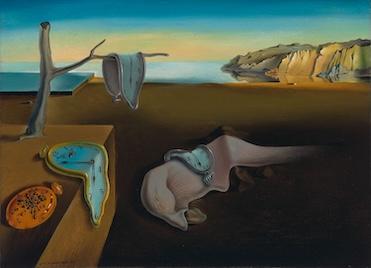
The Persistence of Memory stands as Salvador Dalí's most famous work and an icon of Surrealism . Painted when Dalí was just 27 years old, this small canvas (only 24 x 33 cm) contains imagery that has profoundly influenced popular culture's visual vocabulary.
The melting watches were reportedly inspired by Camembert cheese melting in the sun , though Dalí also linked them to Einstein's theory of relativity and the fluidity of time . The landscape depicts the cliffs near Dalí's home in Catalonia, specifically the Cape of Creus . The distorted creature in the center is a self-portrait in profile, appearing frequently in Dalí's work as his symbolic alter-ego .
Dalí employed his 'paranoiac-critical method' to create this work, inducing hallucinatory states to access subconscious imagery. The painting's hyperrealistic technique , which Dalí called 'instantaneous photography by hand' , creates an unsettling contrast with the impossible, dreamlike content. Each element is rendered with meticulous detail - from the fly on one watch to the ants swarming another (Dalí's symbol for decay).
The closed watch covered in ants may represent death and decomposition , while the open watches suggest the flexibility of time in dreams and memory. The olive tree, dead and broken, contrasts with the distant cliffs' permanence. The work's title suggests that while time may be fluid, memory persists - though perhaps distorted.
Created during Dalí's most productive period, the painting was first exhibited at the Julien Levy Gallery in New York in 1932. It immediately captured public imagination and has since become one of the most recognizable images in 20th-century art, spawning countless parodies and homages.