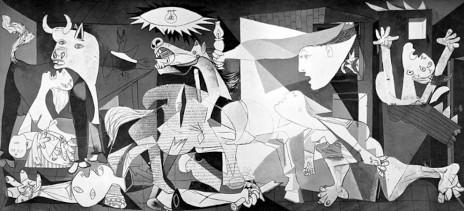
Guernica stands as Pablo Picasso's most powerful political statement and one of the 20th century's greatest anti-war paintings. Created in response to the bombing of Guernica during the Spanish Civil War on April 26, 1937, this monumental work (349.3 × 776.6 cm) was completed in just over a month.
The monochromatic palette of black, white, and gray evokes newspaper photography, emphasizing the work as both historical document and timeless symbol. The fragmented, cubist style perfectly captures the chaos and destruction of modern warfare. Each element carries symbolic weight: the bull (Spain or darkness), the horse (the people's suffering), the light bulb/eye (the 'eye of God' or bomb's explosion), and the woman with lamp (enlightenment).
The composition contains hidden images - a skull overlays the horse's body, formed by its nostril and upper teeth. The bull appears to be formed from the smoke of the lamp. A mother holds her dead child , her tongue shaped like a dagger to express sharp grief. The warrior at the bottom holds both a broken sword and a flower, suggesting defeat but also hope.
Picasso worked in his Paris studio on rue des Grands Augustins, documenting the painting's evolution through 45 preparatory studies and photographs by Dora Maar. When asked about the symbolism, Picasso said: 'The bull is a bull and the horse is a horse... If you give meaning to certain things in my paintings it may be very true, but it is not my idea to give this meaning.'
During World War II, a German officer viewing the painting asked Picasso, 'Did you do this?' Picasso replied: 'No, you did.' The painting toured the world to raise funds for Spanish refugees before residing at MoMA New York until Spain's democracy was restored in 1981.